
This post is the first of a series of articles that provide a behind-the-scenes look at the City’s Mobility Element project. Specifically, the series will illustrate how your Town Hall ideas have been informing the types of analyses being conducted by the City in developing the Element. This first post sets the scene as to why the Departments of City Planning and Transportation are embarking on the project in the first place.
Los Angeles has many clichés; many of them revolve around traffic. We are told that L.A. is the city with a love affair of the automobile—forever wedded to the sedentary freeway commute, squeamish about public transit, dominated by low-density sprawl, smog, and congestion. These stereotypes inevitably reflect certain truths about L.A.’s past, but increasingly they fail to represent the type of city that Angelenos are envisioning for the future. Nor do these clichés reflect the changes that have already occurred over the past decade, like the significant investments in transit infrastructure; shifts in demographics and, correspondingly, mode of travel preferences; and a growing awareness of the limitations imposed by an automobile-first transportation system.
Examples of this desire to move toward a twenty-first century mobility system abound. In 2008, L.A. County voters approved Measure R, a vote to raise the sales tax by half-cent in exchange for greater regional transportation funding for projects like Phase 2 of the Expo Line, Westside Subway Extension, Crenshaw Line, and the Regional Connector. In October of 2011, 130,000 Angelenos turned out for CicLAvia, an open streets event in which 10 miles of streets, spanning from East Los Angeles to Hollywood, were opened for walking, bicycling, recreation, and commerce. The much feared Carmageddon in July turned out to be a non-issue: the closure of the 405 freeway was met with one of the calmest and least congested weekends in recent history. Together, these examples indicate a demand for alternative transportation options, an acknowledgement by Angelenos of the various functions of public streets, and the ability to reduce discretionary vehicle trips when desired—all hallmarks of a flexible mobility system of the future.
This growing attention to transportation issues in Los Angeles has led to higher expectations of how we move around the city and how we can utilize our public streets for mobility. The conversations occurring at our online Town Hall reflect these demands for a higher level of user experience. We now expect cities to maximize the utility of existing street right-of-ways—as opposed to forever expanding the physical roadbed—by expanding transit use, increasing the number of bicycle and pedestrian trips, and optimizing vehicle trips. And, we expect all travel, whether by foot, bicycle, car, truck, bus, or train, to be safer, more reliable, and more comfortable. This multi-modal system would increase confidence in the economic vitality of the city, while also improving health and livability for Angelenos.
Spurred by concerns over climate change and public health, California state legislators, too, have taken an interest in transportation, noting the inextricable links between mobility, obesity, air quality, and greenhouse gas emissions. SB 375, which was signed into law in 2008, requires regional governments to develop Sustainable Community Strategies through integrated land use and transportation planning to attain specified greenhouse gas reduction targets. AB 1358, the Complete Streets Act, requires cities, upon the next update of their circulation element of the General Plan, to develop multimodal transportation networks that accommodate all street users, including motorists, pedestrians, bicyclists, children, persons with disabilities, seniors, movers of commercial goods, and users of public transportation. The Complete Streets Act also contains specific language directing cities to shift more trips toward walking, bicycling, and transit in order to reduce greenhouse gas emissions and vehicle miles traveled.
These statewide mandates, combined with the local demand for an increase in transportation options, have compelled the City to embark on a comprehensive update to its current circulation element, the Transportation Element. Last adopted in 1999, the Transportation Element reflected the needs of a different Los Angeles, one that predated Metro’s Gold, Orange, and Silver rapid transit lines; the buffered green bicycle lanes in Downtown and Boyle Heights; the passage of an extensive Bicycle Plan; and the launch of LADOT’s dynamic ExpressPark system. In the 12-year timeframe since the Transportation Element was adopted, the City’s population has increased by 2.6% and the rapid transit system has expanded from 47 to 74 stations, with another 19 stations planned to open in the City of Los Angeles alone in the next ten years. At the same time, 65% of Angelenos still drive solo to work, and L.A. has the highest collision and injury rates in the State. Too many streets fail to accommodate pedestrians, bicyclists, and transit users; and Los Angeles commute times are seventeenth highest in the nation. The City aims to develop a new plan that accounts for the progress that has been made and the shifts in user expectations while paving the way for many needed improvements.
Mobility Element
The new circulation element will be called the Mobility Element, the draft of which is expected to be released by the summer of 2012. In order to identify goals, objectives, policies, and programs for the new Element, the City will engage in an extensive six-month conversation with Angelenos through its LA/2B campaign, which will include citywide workshops, contests, interactive planning activities, and an online Town Hall. The City will also work with its Mobility Element Task Force of approximately 50 community and industry leaders, including goods movement haulers, emergency coordinators, transit operators, and bus, bike, and pedestrian advocates, as well as local community-based organizations, nonprofits, and college and university groups to develop a draft well-balanced, comprehensive, multimodal Mobility Element policy document.
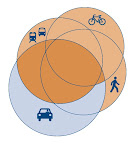
The hallmark of the Mobility Element project is the development of a Layered Street Network, which will prioritize a series of arterial streets for vehicle, transit, bicycle, and pedestrian activities. While, in the spirit of the Complete Streets Act, each street would still accommodate all modes of transportation, the selection of particular “priority” streets for a particular transportation mode will enable improved outcomes of the prescribed mode when on its identified priority corridor. The Layered Street Network concept is the consequence of the Los Angeles Street Classification and Benchmarking System Report that the City developed with transportation consultant Fehr and Peers. During the development of the Report various multimodal network alternatives were reviewed. After looking at several street classification systems in place around the Country, it was determined that a Layered Street Network was the most suitable approach for Los Angeles. The Layered Network facilitates the creation of citywide bicycle, transit, and vehicle routes that can be layered with context sensitive solutions to accommodate pedestrians at specific main street, employment, entertainment, and transit nodes.
Coupled with this Layered Street Network will be the development and adoption of new Street Standards and a Streetscape Design Manual. The new Street Standards will include street cross-sections that accommodate bus, bicycle, pedestrian, and vehicle mobility while the Manual will identify streetscape elements and characteristics—for example, curb extensions, crosswalks, landscaped medians, parkways, sidewalk widths, and pedestrian lights—that are appropriate for each street designation.
The Mobility Element project will also address the tools currently used to evaluate and measure a street’s performance. The auto-centric Level of Service (LOS) transportation performance tool that is currently used evaluates only the impacts that a project will have on the congestion levels of nearby streets. The LOS tool grades a street from A (free-flow traffic) to F (gridlock). When a project is found to increase the congestion on a street above a grade C the project is typically required to mitigate the impacts by installing a variety of measures such as a traffic signal, or left-hand or right-hand turn pocket that will keep the traffic flowing. Unfortunately, these measures can compound the often already compromised bicycle and pedestrian environment (by increasing traffic speeds or the roadway width that a pedestrian has to cross) which further erodes a pedestrian’s or bicyclist’s incentive to continue to walk or bicycle to his or her destination. The utilization of the Network and its “priority” streets will permit the City to identify streets where it is still preferable to utilize the vehicular LOS so that a variety of users including, goods movement, transit, taxis, and emergency vehicles can reliably get to their destination on-time while simultaneously identifying other “priority” streets where tools other than LOS can be used to evaluate and improve the street for pedestrians, bicyclists, or transit operators and users.
And lastly, the Mobility Element project will include the development of an Implementation Strategy that will identify the capital and maintenance costs for implementing and maintaining the Layered Street Network as well as other plan programs. Critical to the overall success of the plan will be a frank dialogue with Angelenos about the current state of funding and the reality of completing the desired improvements within a reasonable amount of time. Based upon public input, the plan will include programs to explore, or take definitive steps towards, the development of a range of funding options.
The completion of the Mobility Element and its proposed Layered Street Network, updated Street Standards, Streetscape Manual, revised performance measurement tools, and Implementation Strategy will provide the platform to shift Los Angeles from its vehicle-only focus and position it as a leading example of twenty-first century multi-modal transportation and mobility options.
Next: Maps
A key challenge with the Layered Street Network approach will be the process to define the various networks and identify specific arterial streets for each network. To complement stakeholder input, the City is conducting various analyses, many of them that have been informed by ideas on LA/2B’s online Town Hall, that look into factors like safety, adjacent land uses, and population density, as well as other pieces of data, to identify suitable networks. In the following posts, we will share these factors of consideration through maps that the City’s Mobility Element team has created.
















 WordPress.com


